If you have ever sourced Tesla floor mats for a retail brand or a distribution business, you probably know this situation. The sample looks right on the table, but once it goes into the car, an edge lifts, a corner won't sit flat, or the mat slides under the pedal. A few of those cases turn into returns and bad reviews.
I design molds and build 3D scan models for car mats. In my experience, whether a set of Tesla floor mats fits well is usually decided long before production starts. It depends on how the data was collected and how the mold was designed. This guide explains how a custom-fit set is actually made, and then gives you a practical checklist for choosing one.

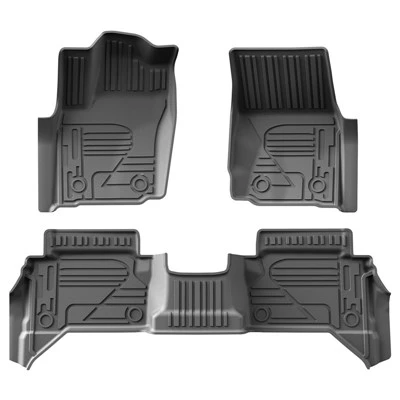
Kangyu TPE Tesla Model 3 Floor Liners
What "Custom-Fit" Really Means
Almost every supplier says their mats are "custom-fit" or "3D scanned." The label alone tells you very little. A scan is only the starting point. These are the steps I go through when I develop a new vehicle model.
1. Precise 3D scan comparison. We scan the vehicle's floor and build a 3D model (3D scan modeling means turning the measured surface of the footwell into digital data we can design from). We then compare that data against the scan to find where the shape is off.
2. Clearance and interference. A mat that matches the floor exactly is not automatically a good mat. In real installation there is a small gap in some places and a tight, pressed-in fit in others. In design terms these are the positive and negative values of the mat data. Positive values leave room, and negative values mean slight interference with the surroundings. We have to decide these value by value, area by area.
3. Material shrinkage. TPE (thermoplastic elastomer, a flexible, rubber-like material that can be molded by heat) shrinks a little as it cools. If the mold is built to the exact floor size, the finished mat will come out slightly small. So we make the mat a little larger on purpose to compensate for the shrinkage.
4. Multiple trial fittings on the real vehicle. Even with all of the above, the data is only a prediction. The mat still has to be installed in a real car, more than once, before I am satisfied. Anyone who tells you they can guarantee a perfect fit without a vehicle trial is skipping a step.
When you assess a supplier, ask them how they handle these four steps. A supplier who can explain them has probably done the work.
Why the Same Tesla Model Is Not Always the Same Floor
The hardest problem I have run into is inaccurate scan data. Many people assume that one scan of one car gives the final answer. It does not.
Vehicles of the same brand and model, built at different times, are not always identical. If you scan one car and design from that single scan, you may build a mold around that one car's small deviations. In practice, we scan the same model from different production batches several times and take a middle value. That way the mat fits the typical vehicle, not one unusual one.
Model refreshes add another layer. Tesla has updated cabin layouts on popular models, such as the Model 3 Highland and Model Y Juniper updates, and it also makes running changes without changing the model name. For a buyer this means "Model Y floor mats" is not one product. A set made for an earlier build can be wrong for a later one even when the name is the same.
For us, Tesla is not a new project. We already have molds for all Tesla models and model years, because we have worked with Tesla-focused customers before and the market is large. That experience matters. We are not starting a development cycle for each inquiry, and we do not rely on one scan of one vehicle.
Five Checks Before You Order Tesla Floor Mats
Here is the buying guide part. These are the five points I would check if I were buying Tesla floor mats for resale.
1. Match the exact model and model year. Ask which generation and year range each set is designed for. A model name alone is not enough. Model 3 and Model Y are different vehicles with different floor shapes, and refreshed versions differ again from earlier ones. If a supplier answers with "it fits all Teslas," treat that as a warning sign.
2. Check the anchoring and pedal clearance. A mat must stay in place and must not interfere with pedal travel. When I trial-fit a mat on a vehicle, I always check how it seats on the car's factory fixing points and whether the driver's area stays clear. This is a safety issue first and an appearance issue second.
3. Choose the material for real use. My own view on what "high quality" means is simple. The most basic requirement is that the mat fits the vehicle. Beyond that, I look at a few things:
"1. The material should be eco-friendly, recyclable, and free of odor; 2. It should stay in place well, be easy to care for, and resist sunlight; 3. The pattern design should be clear and attractive."
For TPE mats, ask about odor and recyclability, and ask how the surface behaves after long exposure to light. These are things your end customers will notice quickly.
4. Understand the forming process. Not all TPE floor mats are made the same way, and the process affects the result.
- Vacuum forming with a male mold: a TPE sheet is heated until soft and drawn over the mold by vacuum, so the upper surface of the mat touches the mold directly. This process copies the mold shape faithfully, gives sharp edges on the top surface, and allows a wide range of textures. It is the core process of our factory.
- Vacuum forming with a female mold: the reverse side touches the mold, so the visible surface is not marked in forming. The result looks natural, and the process is stable with a high pass rate.
- Injection molding: TPE pellets are melted and injected into a mold cavity under pressure. This gives high forming accuracy and reproduces fine mold detail.
In this process the heated TPE sheet is drawn over the mold, so the top surface of the mat touches the mold directly. That is why edges and patterns come out sharp. Male mold forming is the core process at our factory.
Neither is automatically better for every product. What matters is that the supplier can explain why a process suits a given design, and that they control it in-house.
5. Look at pattern clarity and edge finish. Check the pattern on a physical sample, not only on a render. Clear lines, clean edges, and consistent texture tell you a lot about mold quality.
How to Verify a Supplier Before Placing a Large Order
If you are a wholesaler, brand owner, or distributor, the risk is not in one mat. It is in an entire batch that fits badly. These are the checks I recommend.
- Ask for a sample and test it on a real vehicle. With an existing mold, sampling usually takes 3 to 7 days. Install it on a car of the right model and year, and look at the edges, anchor points, and pedal area.
- Ask how batch consistency is handled. A supplier who can talk about multi-batch scanning and trial fitting has dealt with this problem before.
- Check the certifications. The company holds IATF 16949 (the automotive quality management standard), ISO 9001, ISO 45001, and ISO 14001. Product testing includes SGS, RoHS, and CE reports. You can see the details on our 【MOQ, Lead Time & Certifications】page.
- Confirm the order terms. The minimum order is 10 sets per vehicle model, and the same standard applies across product lines.
- Ask about tooling. If you need a new design or a private pattern, our 【In-House Precision Mold Making】 team and 【OEM/ODM Custom Design Services】 can explain how the process works.
A supplier who is open about these points is usually one you can work with over the long term. For an overview of what we make, you can also visit 【China TPE Car Mats Manufacturers】or see our range of 【custom-fit TPE car mats】.
Summary: What to Do Next
If you are planning to source Tesla floor mats, here is the short version:
- Define the exact models and model years you need before you ask for quotes.
- Ask each supplier how they handle clearance, shrinkage, and batch differences.
- Request a sample and test it on a real vehicle, including anchoring and pedal area.
- Check the material (odor, recyclability, light resistance) and the pattern on a physical sample.
- Confirm certifications and order terms before committing to volume.
A good set of custom-fit floor mats comes from engineering decisions that are made early and checked on real cars. That is what I would look for as a buyer.

Male mold vacuum forming on the production floor. When you assess a supplier, ask to see this step, not only the finished mat. How the sheet is formed on the mold decides how closely the final mat follows the design data.
FAQ
- Can Tesla Model 3 floor mats be used in a Model Y?
No. The two vehicles have different floor shapes, so a set made for one will not fit the other properly. Always buy mats designed for the exact model.
- Do I need different mats for refreshed Tesla models?
Yes, in many cases. Updated versions such as the Model 3 Highland and Model Y Juniper have different cabin details, so you should confirm the exact model year range before ordering.
- Are TPE floor mats better than rubber?
For most Tesla owners, TPE is a strong choice. It is eco-friendly, recyclable, and free of odor, and it is easy to clean. The better question is whether the mat fits and is made well, since a poorly made mat in any material will give problems.
- How can I tell if a custom-fit mat will really fit before ordering in bulk?
Order a sample and install it on a real vehicle of the right model and year. Check how the edges sit, whether it anchors properly, and whether the pedal area is clear. This is the most reliable test.
- Do you have molds for Tesla models already?
Yes. We have existing molds for all Tesla models and model years, so sampling does not require building a mold from scratch.