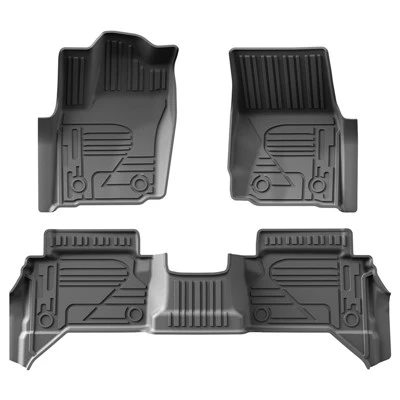
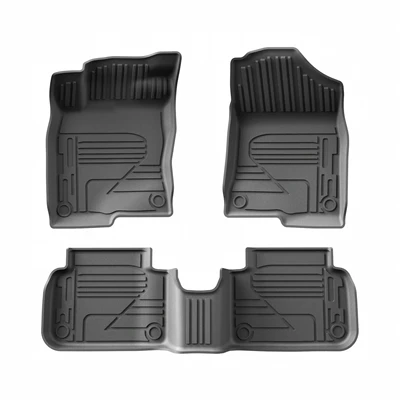
With the continuous development of the automotive industry and rising consumer expectations for vehicle interiors, the car floor mat sector is entering a new stage of technological advancement. As an eco-friendly and high-performance material, TPE (Thermoplastic Elastomer) has become widely used in automotive floor mat manufacturing due to its excellent flexibility, durability, and safety characteristics. In recent years, innovations in material technology, molding processes, structural design, and smart manufacturing have significantly improved the comfort, protection, and service life of TPE car floor mats.
Material modification technology is one of the key foundations behind the development of TPE car floor mats. By optimizing TPE formulations, manufacturers can improve wear resistance, heat resistance, aging resistance, and environmental performance. Modern TPE materials often combine multiple polymer components to achieve both the processing advantages of plastics and the elasticity of rubber. In addition, environmentally friendly additives can further reduce odors and volatile emissions, creating a healthier vehicle interior environment.
Precision molding technology is another core technology used in TPE car floor mat production. Since different vehicle models have unique interior structures, traditional universal mats often struggle to achieve a perfect fit. Today, many manufacturers use 3D scanning, digital modeling, and high-precision mold manufacturing technologies to collect accurate vehicle floor data and develop vehicle-specific mats. These technologies improve coverage, reduce installation errors, and enhance overall stability.
In manufacturing processes, injection molding and compression molding technologies are widely applied in TPE car floor mat production. By accurately controlling temperature, pressure, and molding time, manufacturers can ensure uniform structures and improve dimensional accuracy. The use of automated production equipment also reduces manual errors and helps maintain consistent product quality.
Structural optimization technology plays an important role in improving TPE car floor mat performance. High-quality TPE mats often feature multi-layer composite structures, including wear-resistant surface layers, cushioning layers, waterproof layers, and anti-slip bases. These functional layers work together to enhance water resistance, stain protection, shock absorption, and slip prevention. In addition, raised edge technology effectively prevents liquid overflow and provides stronger protection for vehicle floors.
With the development of smart manufacturing, digital inspection technologies are gradually being introduced into TPE car floor mat production. Automated inspection systems can quickly analyze product dimensions, surface quality, and structural integrity, improving quality control efficiency. Meanwhile, customized manufacturing technologies allow consumers to select products based on vehicle models, interior styles, and personal functional requirements.
Industry experts believe that future TPE car floor mat technologies will continue to develop toward greater sustainability, intelligence, and precision. With ongoing advances in material research and manufacturing processes, TPE car floor mats will achieve further breakthroughs in safety, comfort, and design, providing consumers with higher-quality solutions for automotive interior protection.