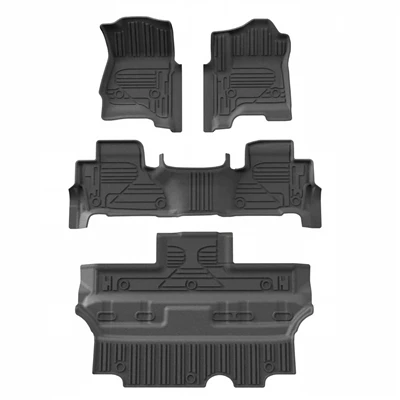
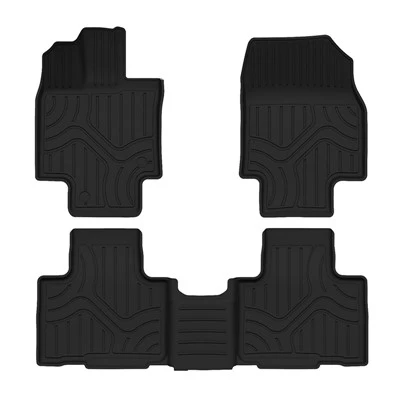
I'm Freya, and I handle overseas inquiries, order follow-up and trade show contacts at Kangyu. In more than three years I've answered about 30 inquiries a day, so I hear what buyers worry about before the first order.
Every year there are new reports on automotive interior accessories: digital cockpits, ambient lighting, smart mirrors. They are interesting, but my customers rarely ask about them. They ask the same five questions: will it fit my model, how fast can you ship, what is your MOQ, can you show certificates, and what is the price?
This article looks at the 2026 trends through those five questions, from the side of a distributor or large-volume buyer.
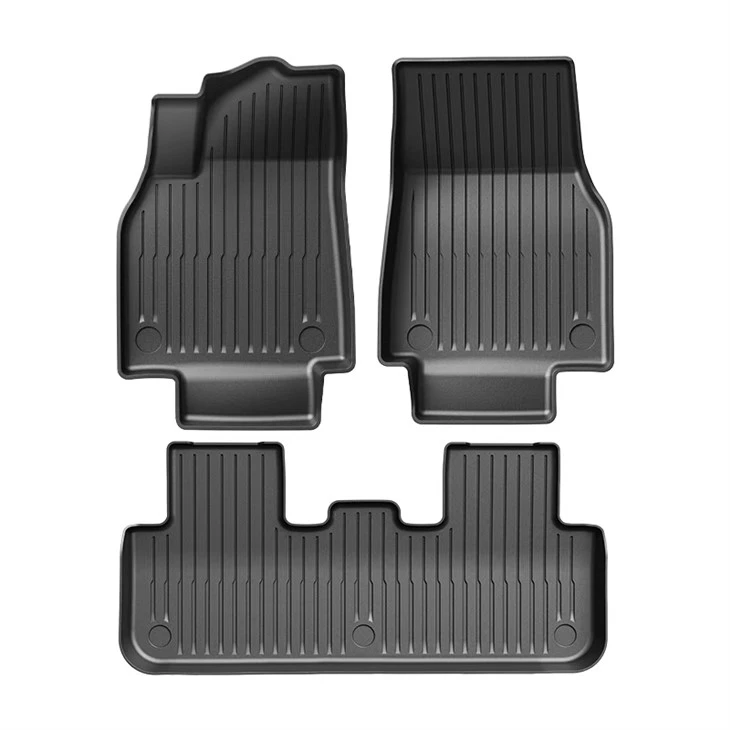
Kangyu TPE Tesla Model Y Floor Liners
Trend 1: Custom-Fit Is Replacing Universal Mats
Among interior accessories, floor protection is where "trend" and "profit" overlap most clearly. A UK market analysis estimates that custom-fit all-weather mats now make up roughly 40–48% of floor mat value, up from about 25–30% a decade ago. A US report puts custom-fit at around 35–40% of revenue. These figures come from paid-report summaries, so read them as estimates. The direction is clear anyway: the segment is moving from flat universal mats to custom-molded liners.
The reason is simple. A universal mat leaves gaps and can slide under the pedals. A custom-fit car floor mat is molded from a 3D scan of the real vehicle, so it covers the footwell and sits securely.
Fitment Is the Hardest Part to Get Right
Our R&D engineer told me the biggest headache is inconsistent scan data. The same model built in different months can differ slightly, so the team scans several production batches of one vehicle and takes the middle value. They also allow for the gap or interference between mat and body, plus material shrinkage, and then verify on a real vehicle. A factory that skips real-car trial fitting is a risk to your return rate.
Our most common return reason is not quality. A buyer ordered the wrong model, and we exchange it. That is why we keep 800+ vehicle molds on file and why every quote starts with a model and year check. If a model has no mold yet, our 【Mold Making service】 takes about 40 days from confirmed order to finished mold.

Kangyu TPE Car Mats In-House Precision Mold Making
Trend 2: TPE Is Replacing Rubber and PVC
TPE (thermoplastic elastomer) is a soft, flexible, recyclable material. It feels like rubber but is lighter, has no strong smell, and stays flexible in the cold. The same UK analysis says TPE-based all-weather mats are growing about 9–13% a year in units as they displace rubber and PVC.
For buyers, the process matters as much as the material, because it decides how the product looks and what it costs. For our 【TPE car floor mats】 we use three methods:
- Vacuum forming, male mold (our core process). A heated TPE sheet (150–280°C) is pulled over the mold by vacuum. The face of the mat touches the mold directly, so edges are crisp and textures are clear. We recommend it for high-end vehicles and large-volume orders.
- Vacuum forming, female mold. The back of the mat touches the mold, so the visible surface stays unmarked and the yield is high. It is our cost-control option.
- Injection molding. Molten TPE is injected into the mold under pressure. It gives the sharpest edges and clear texture on both sides, and it is available in two-color versions for premium custom sets.
When customers ask which to choose, I ask what the order is for. A tight budget points to female mold, a volume program to male mold, and a premium retail line to injection or two-color.
Quality still varies in this category. Buyer reviews quoted in an Alibaba sourcing guide mention edge curling, coating peeling and fading after 6–18 months. That is why I send customers the material and certificate details first. We hold IATF 16949, ISO 9001, ISO 14001 and ISO 45001, plus SGS and RoHS test reports and CE conformity documents for our car floor mats.
Trend 3: Personalization Means Color, Texture and Logo
The luxury trend articles talk about bespoke materials and leather. In wholesale, personalization usually means three practical things: color, surface texture and the buyer's own logo. In our experience, European and American buyers lean toward logo customization for private-label programs. Our 【OEM/ODM customization】 covers logo embossing, color matching, private label and custom packaging.
We make colors and textures in bulk, and our common colors are black and orange, though any color is possible. For color matching I ask for a physical sample, because a physical sample reduces deviation more than a code number does. Our lab checks color difference with a colorimeter.
For a double-layer carpet-top mat, the structure is a polyester velour top over a TPE base about 2.7–3.3 mm thick. The top gives comfort and sound damping, and the base gives waterproofing and structure. Our best-selling surface series include a wear-resistant mat, a starry-sky mat, a pineapple-texture mat and a galaxy mat.
Trend 4: Smaller Orders, Faster Turns
2026 is not an easy year for the aftermarket. SEMA's 2026 report describes tariffs, inflation and higher oil prices, and says many distributors and retailers tried to reduce inventory. Another market study notes that aftermarket distributors looked for value-engineered SKUs to lower landed cost. The same SEMA report says EV growth is slower than many expected, with some automakers shifting back toward ICE and hybrids.
In practice, buyers want to avoid big stock bets on a single powertrain or a single model. So we keep ready stock for all 【Tesla floor mats】 and all Toyota models, at least 20 sets per model, and we can start development of a new model as soon as it launches. Our usual lead times are:
| Order type | Lead time |
|---|---|
| In-stock models | 3–5 days |
| Standard custom orders | 7–10 days |
| New mold development | About 40 days |
The MOQ is 10 pieces, with no difference between product lines. For wholesale orders of 100 pieces, we can discuss free tooling. Samples are charged at the finished-product price and refunded in full once you place an order.
The 40-day mold timeline is not theory. A US and Europe cross-border e-commerce company came to us with a model we had no mold for. We delivered the finished mold in 40 days.
Inside Kangyu's Car Floor Mat Mold Workshop
A Buyer's Checklist
These are the questions I would ask any supplier before an order:
- How do you verify fitment? Ask about 3D scanning and trial fitting on a real car.
- Which process is used, and why? The answer should match your price tier.
- Which certificates can you show? Ask for the reports, not only the logos.
- What are your MOQ, sample rules and lead times, in writing?
- How is it packed and loaded? Our carton is 75 × 20 × 56 cm, one set per box (5.5 kg, 0.08 CBM), and a 40HQ holds 700–900 boxes. On wooden pallets, a 40HQ holds about 2,200 sets. These are reference figures, and the packing list is final.
- What happens when something goes wrong? Our defect example was deformation, and the fix was refining the mold. We back our mats with a 6-year warranty.
Customers Who Showed Me What Works
At a trade show I met a distributor from the Middle East. Since then, every time he contacts me, he sends a photo of a real car and asks, "Can you make this?" I answer, and he orders. In January 2026 his order covered nearly 10 brands and about 50 models. In June he came back with about 100 models from other brands. He did not need a trend report. He needed fast answers and mats that fit.
Another example: an Australian customer first emailed us in April 2026 and ordered several models of one premium SUV brand in volume. A US cross-border seller bought finished sets worth about RMB 1 million, mainly for one popular electric model. Different markets, same logic: quick confirmation of fitment, then stable delivery.
Conclusion: What To Do This Quarter
- Prioritize car floor mats among your interior accessories, because they are closest to repeat demand.
- Shift part of your universal range to custom-fit TPE car mats for your top-selling models.
- Start small with a 10-piece MOQ test order across several models before committing to deep stock.
- Ask for samples, certificates and a clear lead-time table before you decide.
- Request logo, color and packaging options early if you plan a private-label line.
If you send me your target models and markets, I can check mold availability and give you a quote. 【Contact us for samples】 or send your vehicle list to our email.
Frequently Asked Questions
Are Custom-Fit Car Floor Mats Worth It for Resellers?
For most resellers, yes. They cost more than universal mats but sell at a higher price, and they return less when the fit is right. Buyers on marketplaces compare fit before price.
What Is the Difference Between TPE and Rubber Car Mats?
TPE is lighter, has little odor and stays flexible in the cold, and it is recyclable. Rubber is common for heavy-duty and fleet use. For a passenger-car retail line, TPE is usually easier to position.
How Do I Choose Between Male Mold, Female Mold and Injection?
Choose male mold for sharp texture on high-end or large-volume orders, female mold to control cost, and injection for the sharpest edges or two-color premium sets.
What Is the Minimum Order Quantity for Custom Car Mats?
Our MOQ is 10 pieces. Stock models ship within 3–5 days and new molds take about 40 days.
Can I Put My Own Logo on the Mats?
Yes. We support logo embossing, color matching, private label and custom packaging.