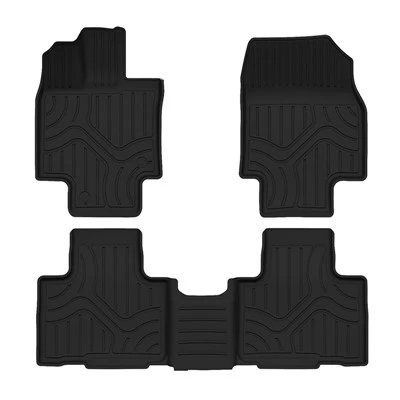
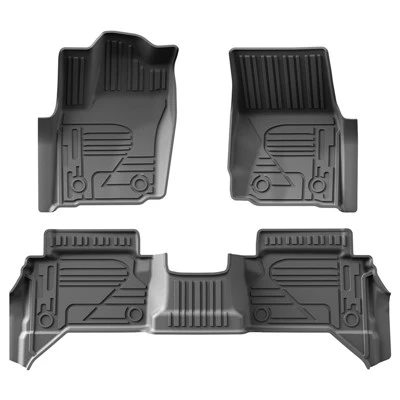
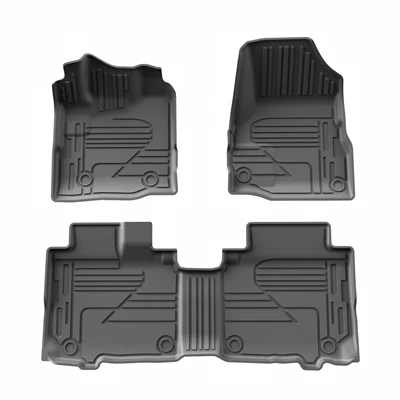
Choosing a car mat manufacturer in China is rarely difficult because there are too few suppliers. The real challenge is deciding which factory can consistently deliver the same fit, material quality, and finish after your first sample becomes a 500-, 1,000-, or 10,000-set order.
A sample may look excellent when you receive it. But B2B buyers can face very different problems during mass production: inconsistent fitment, curled edges, surface defects, delayed delivery, or difficulty developing new vehicle models.
That is why choosing a car mat manufacturer in China should go beyond comparing price, MOQ, and factory size. A reliable supplier should have a repeatable manufacturing system covering vehicle data, tooling, material selection, production processes, quality control, and delivery.
Here are the key factors to verify before placing your first bulk order.

1. Start With Fitment, Not Factory Size
For wholesale car mats, precise fitment is one of the first things a buyer should verify. A manufacturer may have a large factory and hundreds of products, but that does not automatically mean every vehicle application is accurately developed.
Ask the manufacturer how it collects and validates vehicle data. A professional car floor mat manufacturer should be able to explain its process for 3D scanning, data processing, mold development, and real-vehicle testing rather than simply saying that its products are "custom fit."
For example, Kangyu's development process includes 3D scanning, data collection, mold development, sample production, and trial installation. Its engineering team also notes that the same vehicle model can vary between different production batches, so multiple scans may be needed to establish reliable data. Fitment also has to account for installation clearances, interference, and material shrinkage.
For a B2B buyer, this matters because a fitment problem is not limited to one defective mat. It can affect an entire SKU, create returns, and increase replacement costs.
When evaluating a custom car floor mats manufacturer, ask:
- How was the vehicle data collected?
- Was the product tested on a real vehicle?
- How is fitment validated before mass production?
- How does the factory handle changes between model years or production batches?
2. Check the Factory's Tooling Capability
The next question is not simply "How many molds do you have?" It is "Can you manage tooling throughout the product's life cycle?"
Tooling affects fitment, surface details, consistency, and development speed. A factory with in-house mold development can generally respond more directly when a sample requires adjustment.
Kangyu currently reports more than 800 vehicle-specific molds and an annual investment of more than RMB 5 million in product development and mold development.
For a buyer working with many models, this can be especially important. Existing tooling can shorten development time, while new-model projects require a clearly defined tooling process. Kangyu's current development information gives a reference of about 40 days for a new mold from order confirmation to mold completion.
You can learn more about the technical side through 【In-House Precision Mold Making】.
The key point is simple: do not judge a China car mat factory only by the number of machines on the production floor. Evaluate whether its tooling system can support your current products and future model expansion.
3. Ask Why a Specific Manufacturing Process Is Used
A common mistake when comparing suppliers is to focus on whether a manufacturer uses vacuum forming or injection molding without asking why that process was selected.
A professional TPE car mat manufacturer should be able to connect the manufacturing process with your product positioning, order volume, surface requirements, and budget.
Kangyu uses three main molding processes: male-mold vacuum forming, female-mold vacuum forming, and injection molding. Its internal production experience identifies male-mold forming and injection molding as suitable options for higher-end applications, while male-mold forming can also be used for large-volume orders and female-mold forming can be considered for cost-control applications.
The difference is important for buyers because "more advanced" does not always mean "better for every project."
Before selecting a process, discuss:
Product positioning: Is the product intended as a premium or value-oriented line?
Order volume: Will you order several dozen sets or thousands of sets?
Surface requirements: How important are texture clarity, edge definition, and appearance?
Customization: Do you need special colors, textures, logos, or structural features?
For a deeper explanation, consider linking to 【Car Mat Manufacturing Process】.

4. Verify Repeatability, Not Just the First Sample
This is one of the most important questions for any B2B buyer:
Can the factory reproduce the approved sample consistently?
A first sample can be excellent because engineers pay extra attention during development. The bigger test begins after the production line starts making hundreds or thousands of units.
Look for evidence of process control, material consistency, dimensional inspection, and documented quality checks.
Kangyu's quality-control process includes incoming material inspection, in-process quality control, and outgoing inspection. Its quality team checks dimensions, appearance, and odor, while new vehicle applications are validated through repeated real-vehicle trial installation.
This is also why certifications should be evaluated together with actual manufacturing practices. Kangyu holds IATF 16949, ISO 9001, ISO 14001, and ISO 45001 management-system certifications, along with third-party SGS and RoHS-related product testing documentation.
For more detail, buyers can review 【Certifications & Quality Standards】.
A certificate does not replace a sample inspection. Instead, it should support a broader system of documented quality management.
5. Find Out What Happens When Something Goes Wrong
Every manufacturer has production problems from time to time. What separates a reliable supplier from an unreliable one is often the response.
Instead of asking only:
"Do you have quality control?"
ask:
"What happens when a sample or production batch fails inspection?"
This question can reveal much more about a supplier's engineering culture.
For example, Kangyu's quality team documented a case in which mold wear and uneven areas contributed to curled edges on finished mats. The issue was addressed through mold repair, grinding, testing, and adjustment before the product was revalidated.
For B2B buyers, a supplier's corrective-action process matters because quality problems are inevitable at some point. The real procurement risk comes from suppliers that cannot identify the root cause or prevent the same problem from recurring.
6. Evaluate the Entire Manufacturing Chain
Factory photos can show you machines, warehouses, and workers. They do not necessarily show you how well the entire supply chain is controlled.
For large-volume wholesale car mats, look at the complete production chain:
Raw materials → sheet production → forming/injection → trimming → assembly → inspection → packaging → warehousing → shipping
Kangyu's reported supply chain covers 12 internally controlled stages from raw material storage through final delivery. Its ERP system coordinates finance, materials, warehouse operations, and order management.
This type of vertical control can reduce communication gaps between different production stages and make order management more predictable.
For buyers planning long-term cooperation, 【One-Stop Turnkey Manufacturing】 is a useful internal resource to explain how this type of production model works.

7. Compare MOQ, Lead Time, and Capacity Together
MOQ and lead time are common comparison points, but they should never be evaluated separately.
A supplier offering a low MOQ may not necessarily be the right partner if production becomes difficult when your order volume grows.
Conversely, a factory with high capacity may not be flexible enough for an emerging brand testing new SKUs.
Kangyu currently states a minimum order quantity of 10 pieces, with typical delivery times of 3–5 days for stock products, 7–10 days for standard customization, and about 40 days for mold-development projects.
The company also reports an annual capacity of about 2 million sets and an average daily production output of around 3,000 sets.
When comparing suppliers, ask for lead times under three different scenarios:
- Existing mold + stock product
- Existing mold + customized product
- New vehicle model + new mold
This gives you a much more realistic picture of the supplier's capabilities.
8. Check OEM, ODM, and Private-Label Support
For distributors, Amazon sellers, automotive retailers, and independent brands, the product itself is only part of the purchase.
You may also need:
- Custom colors
- Logo embossing
- Custom packaging
- Private-label products
- Vehicle-specific tooling
- Product development
- Mixed SKU orders
A suitable OEM car mats supplier should be able to explain what can be customized, what requires a new mold, and how customization affects MOQ and lead time.
Kangyu supports OEM/ODM services including logo customization, color customization, vehicle-specific mold development, and packaging customization. Its current customer profile also includes overseas distributors, e-commerce sellers, independent brands, automotive stores, and importers.
For brands building their own product line, 【OEM/ODM Custom Design Services】 should be one of the most relevant internal links.
9. Verify Material Quality and Product Performance
For TPE floor mats, material choice directly affects the user experience and long-term product performance.
Kangyu's product information identifies 100% new TPE material as a core material choice, with characteristics including low odor, water resistance, slip resistance, wear resistance, and recyclability. Internal testing experience also records good resistance to sunlight and low-temperature embrittlement.
For a TPE car mat manufacturer, do not stop at asking "Is the material TPE?" Ask for the specific material documentation relevant to your market and application.
You can also ask:
- Is virgin or recycled material used?
- What compliance documents are available?
- How is odor controlled?
- How is material consistency maintained between batches?
- Can samples be tested before a bulk order?
The answers will help you distinguish genuine material management from simple marketing language.
10. Test the Supplier Before Scaling the Order
The safest approach is not to choose a manufacturer entirely from a website, quotation, or trade-show conversation.
Use a staged procurement process:
Step 1: Request samples.
Check fitment, texture, edge finishing, odor, anti-slip performance, and overall appearance.
Step 2: Review technical information.
Ask about materials, tooling, certifications, production process, and quality control.
Step 3: Test a small commercial order.
See whether communication, packaging, delivery, and product consistency match the sample.
Step 4: Scale only after performance is verified.
This is particularly important when you plan to launch many vehicle SKUs at once. A manufacturer may be capable of producing one model well but struggle to maintain consistency across dozens of models.
For B2B buyers, the real goal is therefore not simply to find a car mat manufacturer in China with a competitive quotation. The goal is to find a manufacturing partner whose development, production, and quality systems can support repeat orders.
Final Checklist for Choosing a Car Mat Manufacturer in China
Before placing a bulk order, make sure you can answer "yes" to most of these questions:
- Can the supplier explain exactly how vehicle fitment is validated?
- Does it have a clear tooling and mold-development process?
- Can it explain why a specific manufacturing process is suitable for your product?
- Does it have documented quality-control procedures?
- Can it demonstrate how production problems are identified and corrected?
- Can it maintain consistent quality during repeat orders?
- Does its capacity match your expected order growth?
- Are MOQ and lead times clearly defined?
- Can it support OEM, ODM, or private-label requirements?
- Can it provide relevant compliance and product documentation?
The biggest mistake in supplier selection is treating the lowest quotation, largest factory, or highest number of SKUs as proof of manufacturing capability.
A reliable car floor mat manufacturer should be able to show something more important: a controlled system that turns accurate vehicle data into a good sample, a good sample into stable mass production, and stable production into reliable repeat orders.
For B2B buyers, that is the difference between simply buying car mats from China and building a dependable supply chain.
FAQ
Q: How do I verify whether a car mat supplier in China is a real manufacturer?
A: Ask for evidence of its production facilities, tooling capability, production processes, quality-control procedures, and supply-chain management. An on-site factory audit or third-party inspection can provide additional verification.
Q: What is a typical MOQ for wholesale car mats?
A: MOQ varies by supplier, product, and customization requirements. More importantly, ask whether the MOQ is calculated per SKU, per vehicle model, or per total order. A supplier may offer a low MOQ for standard products but require a different quantity for customized or new-mold projects.
Q: How long does it take to produce custom car mats?
A: The lead time depends on whether the manufacturer already has the required mold. For example, Kangyu currently lists approximately 3–5 days for stock products, 7–10 days for standard customization, and around 40 days for new mold development.
Q: Should I choose a car mat manufacturer or a trading company?
A: A manufacturer can offer more direct control over production, tooling, quality, and customization, while a trading company may provide access to multiple factories or product categories. The right choice depends on your sourcing requirements, but buyers should verify who actually controls production before making a decision.
Q: What should I check before placing a large OEM car mat order?
A: Start with fitment validation and samples, then review tooling, materials, quality control, production capacity, lead time, customization capability, and compliance documentation. A small commercial order can also help confirm whether the manufacturer's mass-production performance matches the approved sample.