For many B2B buyers, sourcing automotive floor mats still starts with a simple question: What is the unit price?
But in actual purchasing conversations, price is rarely the only factor that determines whether an order works. Distributors, importers, e-commerce sellers, and regional buyers usually need to consider vehicle fitment, material quality, MOQ, lead time, certifications, customization, packaging, and the supplier's ability to deliver consistently.
That is why the most important automotive floor mat market trends in 2026 are not only about market growth. They are also about how buyers evaluate products and suppliers.
In this article, I will look at the 2026 automotive floor mat market from a practical B2B sourcing perspective and explain what these trends mean when you are selecting an automotive floor mat manufacturer.
1. The Automotive Floor Mat Market Is Growing - But Market Size Alone Does Not Tell Buyers Enough
Published market estimates for 2026 vary depending on the research firm's market definition and segmentation. Fortune Business Insights estimates the global automotive floor mat market at USD 13.35 billion in 2026, with a projected CAGR of 4.20% through 2034. A September 2026 report from 360iResearch estimates the 2026 market at USD 14.44 billion, reaching USD 19.93 billion by 2032 at a 5.47% CAGR.
The difference is a useful reminder for buyers: market reports are valuable for understanding direction, but the headline market size should not be treated as the only purchasing signal.
The broader trend is clearer. Current industry research describes automotive floor mats as moving from a basic interior accessory toward a more performance-oriented category influenced by vehicle electrification, personalization, sustainability, safety expectations, and aftermarket expansion.
For a B2B buyer, the practical question is therefore not simply, "Is the market growing?"
It is:
Which product characteristics are becoming more commercially important, and can my supplier support them at scale?

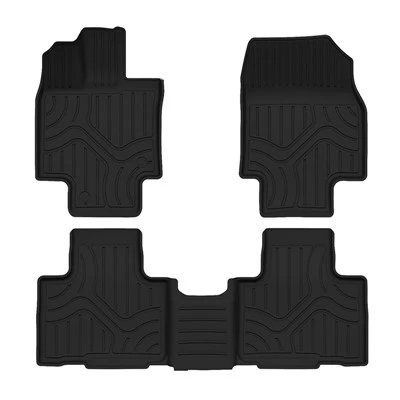
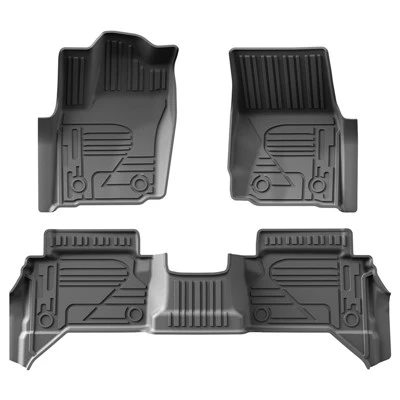
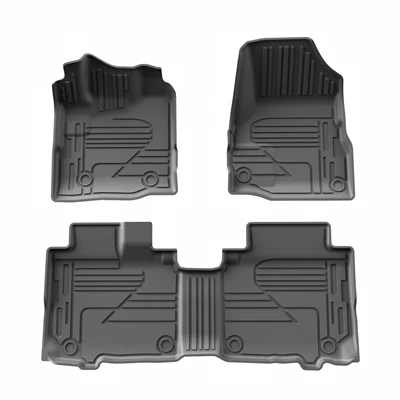
TPE Toyota Camry floor liners
2. TPE Is Becoming More Relevant as Buyers Look Beyond Basic Protection
Traditional automotive floor mats have long been associated with rubber, textile, carpet, and other common materials. However, TPE, or thermoplastic elastomer, is receiving more attention because it combines flexibility with the ability to be processed into vehicle-specific shapes.
Industry research has identified TPE mats as one of the faster-growing material segments, citing factors such as design flexibility, odor resistance, customization, recyclability, and the ability to support different colors and surface designs.
From a sourcing perspective, however, the word "eco-friendly" should not be enough.
Before placing a bulk order, buyers should ask:
- What is the actual material used?
- Is virgin or recycled material being used?
- What compliance documents are available?
- Has the finished product been tested?
- Is the material performance consistent from batch to batch?
At Kangyu, TPE is the core material for vehicle-specific floor mats, and the company states that it uses new, unused TPE material and recyclable material. Its product certification framework includes IATF 16949 and ISO management systems, together with SGS and RoHS-related testing documentation.
For buyers who want to evaluate material claims in more detail, a useful internal reference is 【TPE Car Mat Knowledge】
3. Vehicle-Specific Fitment Is Becoming More Important Than "One-Size-Fits-Most"
One of the most common questions we receive from overseas buyers is whether a floor mat will precisely fit the target vehicle.
This matters more than it may appear at first.
A poor fit can create gaps, interference, movement, poor pedal clearance, or customer complaints. For distributors and online sellers, incorrect fitment can also create returns, exchanges, negative reviews, and unwanted inventory.
This is why vehicle-specific floor mats are becoming an increasingly important purchasing category.
Research reports still show strong demand for standard and universal-fit products, especially because they are widely available and generally more affordable. At the same time, customization and EV-specific applications are becoming important areas of growth and differentiation.
The technical process behind precise fitment also matters. At Kangyu, vehicle development includes 3D scanning, data processing, mold development, sample production, and real-vehicle trial fitting. The engineering team has also identified a practical challenge that buyers may not see: even the same vehicle model can have dimensional differences between production batches, so scanning and real-vehicle validation cannot always be replaced by a single reference drawing.
For B2B buyers, this leads to an important supplier-selection rule:
Do not ask only whether a supplier has the vehicle model. Ask how the supplier verifies fitment.
You can learn more about the production side through 【In-House Precision Mold Making】.
4. Manufacturing Process Now Affects Quality, Cost, and Product Positioning
Another trend I see from the sourcing side is that buyers increasingly need to understand how a floor mat is made, not only what material is used.
For TPE automotive floor mats, different manufacturing processes can produce different commercial outcomes.
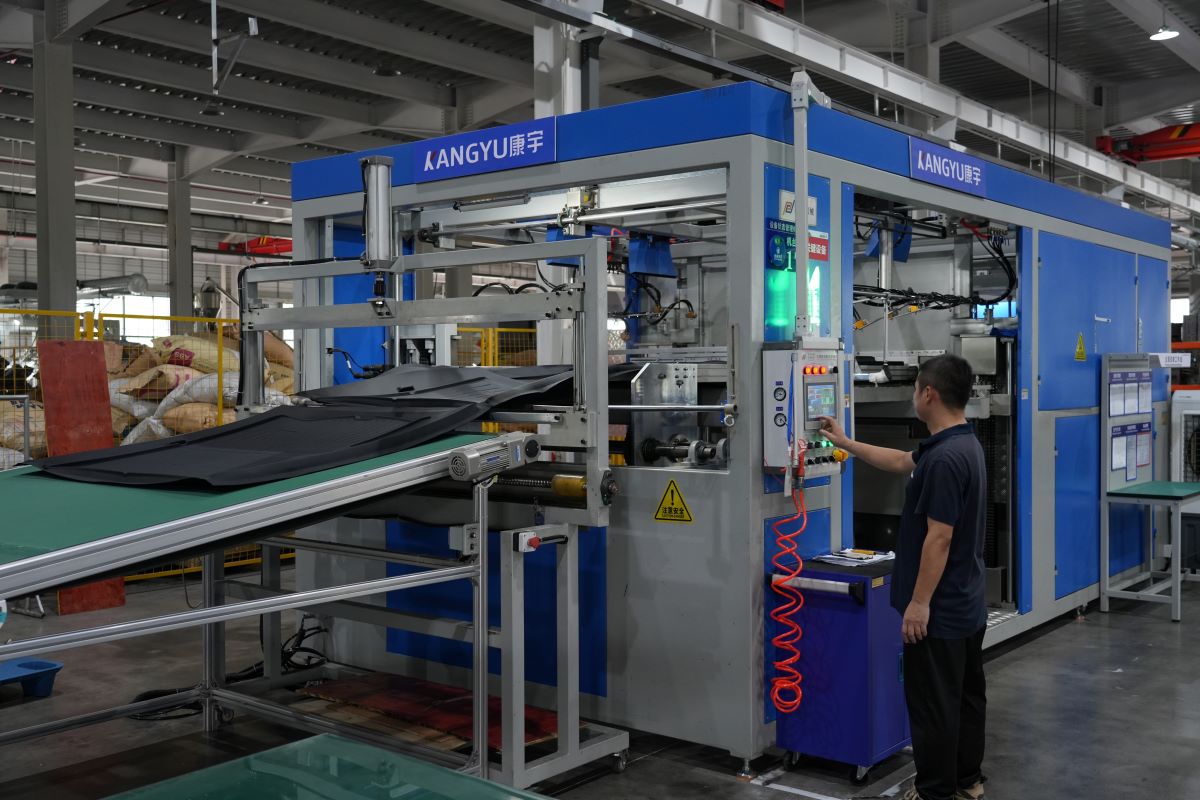
Male-Mold Vacuum Forming
In male-mold vacuum forming, the TPE sheet directly contacts the mold surface during forming. This allows detailed surface reproduction and is particularly useful when buyers want strong texture definition and a refined appearance.
Female-Mold Vacuum Forming
Female-mold forming uses the opposite contact direction. It can offer stable tooling performance and can be useful for cost-conscious programs.
Injection Molding
Injection molding melts TPE material and injects it into a mold cavity. This process can provide high dimensional precision and clear detail on both sides of the product.
The important point for buyers is that there is no single "best" process for every order.
The right process depends on the target vehicle, expected quality level, order volume, product design, and cost structure. Based on Kangyu's manufacturing experience, male-mold vacuum forming and injection molding are positioned for higher-end applications, male-mold forming can be particularly suitable for large-volume programs, while female-mold forming can be used as a cost-control option.
For a buyer comparing suppliers, this is a much more useful question than simply asking, "Do you produce TPE mats?"
A practical internal resource here is 【Manufacturing Knowledge】.
5. Supplier Selection Is Moving Beyond Unit Price
A low unit price can look attractive on a quotation sheet. But the lowest quoted price does not necessarily produce the lowest overall sourcing cost.
For B2B orders, the total cost can also be affected by:
- fitment problems
- defective products
- delayed replenishment
- excessive MOQ
- slow sample approval
- poor packaging
- inconsistent quality
- limited vehicle coverage
This is why I recommend looking at total purchasing risk, not only product price.
Before placing an order, I normally suggest checking at least five operational points.
MOQ: Can the supplier support trial orders as well as bulk programs?
Lead time: How quickly can standard products, custom products, and new molds be delivered?
Vehicle coverage: Does the supplier already have the models you need, and can it develop new models?
Quality system: Are there documented incoming, in-process, and outgoing inspection procedures?
Order communication: Is there a clear process for samples, specifications, approval, production updates, and shipment?
Kangyu's current published capabilities include a 10-piece minimum order quantity, approximately 3–5 days for stocked products, 7–10 days for standard customization, and about 40 days for new mold development.
Its manufacturing system also combines production, warehouse, materials, finance, and order management through ERP, while the company operates under IATF 16949, ISO 9001, ISO 45001, and ISO 14001 systems.
6. Customization Is Becoming a Commercial Tool, Not Just a Premium Feature
Customization used to be associated mainly with luxury products. In 2026, it is increasingly relevant to distributors, private-label brands, and e-commerce sellers that need product differentiation.
Customization can include:
- vehicle-specific dimensions
- colors
- surface texture
- logos and branding
- packaging
- private-label presentation
The commercial value is straightforward. A distributor selling a generic black floor mat competes primarily on price and availability. A brand offering a vehicle-specific product with its own colors, logo, packaging, and fitment story has more opportunities to differentiate.
Kangyu's OEM/ODM service supports dimensions and fit, color matching, logo and branding, TPE materials, and different surface finishes. The company also describes a standardized workflow from requirement discussion and design to mold development, sample approval, mass production, and inspection.
For buyers planning a private-label program, another useful internal page is 【OEM/ODM Custom Design Services】 .

7. EVs Are Expanding the Need for Vehicle-Specific Product Development
Electric vehicles are another important trend shaping the automotive floor mat market.
The fundamental purpose of a floor mat does not change simply because a vehicle is electric. However, EV adoption is encouraging demand for newer vehicle platforms, more distinctive interior designs, and model-specific accessories. Current industry research identifies electric vehicles as a high-growth application within the wider floor mat market.
From a sourcing perspective, this means buyers should look at development speed, not only existing SKU count.
A supplier may have hundreds of established molds but still struggle to respond to newly launched models. A manufacturer with an established development process can be more useful when an e-commerce seller or distributor wants to launch products soon after a vehicle enters the market.
Kangyu states that its development process includes 3D scanning, data collection, mold development, sampling, and trial fitting, and the company aims to develop corresponding mats alongside new vehicle launches.
More information can be connected through 【EV & New Energy Vehicle Compatibility】.

8. The 2026 Supplier Checklist: What Should Buyers Verify?
When comparing automotive floor mat manufacturers, I recommend using a simple checklist rather than comparing quotations alone.
- Fitment: Is the product genuinely vehicle-specific, and how is the fit validated?
- Material: What TPE or other material is used, and what documentation supports the environmental and safety claims?
- Manufacturing: Which process is being used, and why is it suitable for this order?
- Customization: Can the supplier support color, logo, texture, packaging, and private-label requirements?
- Quality: What systems and inspections are in place before shipment?
- MOQ: Is the MOQ practical for both trial orders and repeat purchasing?
- Lead Time: How quickly can samples, standard products, and new molds be delivered?
- Supply Capacity: Can the factory support your future volume if sales increase?
- Communication: Can one team coordinate specifications, samples, production, inspection, and shipment?
Kangyu currently operates a 30,000 m² production base with an annual production capacity of about 2 million sets, more than 800 vehicle mold references, a 100+ member team, and dedicated R&D and quality-control personnel.
Those numbers are useful not because a larger factory is automatically better, but because they help buyers assess whether a supplier has the infrastructure to support a growing product program.
Conclusion: In 2026, Buyers Should Think Beyond the Lowest Quote
The automotive floor mat market is expanding, but the more important change for B2B buyers is the shift in purchasing criteria.
The market is moving toward vehicle-specific fitment, material-conscious products, customization, EV applications, and more reliable supply capability. Current research supports these broader trends, while real purchasing experience shows that buyers continue to focus heavily on fitment, MOQ, lead time, certifications, price, samples, and supplier responsiveness.
So when comparing suppliers in 2026, I would not start with only one question:
"Who offers the lowest price?"
I would start with:
"Who can give me the right fit, the right manufacturing process, the right compliance support, and reliable delivery at the volume I need?"
That question usually leads to a much more sustainable sourcing decision.
FAQ
Q: What are the biggest automotive floor mat market trends in 2026?
A: Key trends include growing demand for vehicle-specific products, increased attention to TPE and sustainable materials, customization, EV-related applications, and stronger expectations for supplier reliability and quality assurance.
Q: Is TPE better than rubber for automotive floor mats?
A: There is no universal answer. TPE offers advantages such as flexibility, design options, odor resistance, and recyclability, while the best material depends on the vehicle, application, target price, and product positioning.
Q: Why is fitment so important for B2B floor mat buyers?
A: Poor fitment can lead to customer complaints, returns, exchanges, and inventory problems. For vehicle-specific products, buyers should verify not only the final dimensions but also the supplier's scanning, tooling, and real-vehicle validation process.
Q: What should I ask an automotive floor mat manufacturer before placing a bulk order?
A: Ask about fitment validation, material specifications, certifications, MOQ, sample policy, lead time, mold availability, production capacity, quality inspection, customization, and packaging.
Q: How can distributors reduce sourcing risk?
A: Start with a sample and confirm fitment before scaling up. Then evaluate the supplier's production process, quality system, delivery performance, and ability to support repeat orders and new vehicle models.