When buyers contact me about car mats, one of the first questions I usually hear is: "What is your MOQ?"
It sounds like a simple question, but in practice, the answer is rarely just one number.
I have worked with overseas distributors, e-commerce sellers, importers, and other B2B buyers for more than three years, and I have seen buyers compare suppliers based almost entirely on MOQ. One factory may quote 50 sets, another 200, and another 500 per model. At the same time, some buyers expect to order only a few sets of each vehicle model because they want to test the market first.
So which MOQ is "normal"?
From my experience handling overseas inquiries and orders, the more useful question is not simply "What is the MOQ?" It is:
"MOQ for what, exactly?"
Does the MOQ apply per set, per vehicle model, per color, per SKU, or per purchase order? Does it change when you need a new mold, custom packaging, or a private-label logo? And just as importantly, can you start with a small order and reorder the same products reliably?
For B2B buyers, understanding these details is often more important than finding the lowest number.

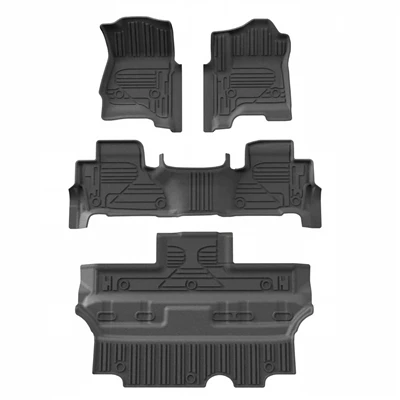
TPE Ram Double Cab Floor Mats
There Is No Universal MOQ for Car Mats
The first thing I recommend is avoiding the idea that there is one fixed "industry standard" MOQ for all car mats.
Car mats are not a single standardized product. A manufacturer may supply ready-to-order products using an existing mold, while another project may involve a new vehicle model, custom colors, custom branding, or new packaging.
These situations create very different production requirements.
At Kangyu, our confirmed minimum order quantity is 10 pieces, but that does not mean every buyer or every project should simply order 10 pieces. The practical order quantity depends on what the customer is buying and how the order is structured.
For example, a buyer testing a few existing products may have a completely different purchasing plan from a distributor preparing inventory for 20 vehicle models.
That is why I always encourage buyers to look beyond the headline MOQ.
The First Question to Ask: What Does the MOQ Cover?
This is one of the most common sources of confusion in supplier communication.
When a supplier says "MOQ 100," ask what the 100 refers to.
It could mean:
- 100 pieces in total
- 100 sets of car mats
- 100 sets per vehicle model
- 100 sets per color
- 100 sets per SKU
- 100 sets per purchase order
Those are very different commercial conditions.
Imagine a distributor wants to test eight vehicle models, and the supplier requires 50 sets per model.
The actual quantity is:
50 sets × 8 models = 400 sets
If two colors are also treated as separate SKUs, the potential inventory exposure can become:
50 × 8 × 2 = 800 sets
So when you compare two suppliers, do not compare "50 MOQ" with "100 MOQ" before confirming how each supplier calculates it.
This is particularly important for distributors and e-commerce sellers who are trying to build a catalog covering many vehicle models.
At Kangyu, we have also handled mixed-SKU orders. In one documented customer feedback example, a buyer ordered six SKUs with five pieces of each SKU and requested separated packaging and detailed shipping identification.
For a multi-model business, that kind of flexibility can be much more meaningful than a low MOQ number on its own.
Existing Mold vs. New Mold: A Major Difference
Another factor I tell buyers to consider is tooling.
A car mat is usually designed around a specific vehicle floor shape. That means the manufacturer's existing mold resources can have a direct impact on how quickly and efficiently a project can move forward.
Kangyu currently has 800+ vehicle molds covering major domestic and international vehicle models, together with an in-house mold development capability. The company also invests more than RMB 5 million annually in product R&D and mold development.
For an existing vehicle model with an available mold, the discussion can focus mainly on quantity, material, color, packaging, and other order specifications.
For a new vehicle model, however, development becomes part of the project.
Our development process can include 3D scanning, data processing, product design, mold manufacturing, trial samples, and real-vehicle fitment testing before mass production.
This is why I recommend that buyers separate two questions:
What is my production MOQ?
and
Does this project require new tooling?
They affect the project in different ways.
MOQ Also Changes with Customization
Customization is another area where buyers often expect a simple answer but actually need to discuss several variables.
For standard products, the main questions may be vehicle model, quantity, and delivery date.
For an OEM or private-label project, you may also need:
Custom logo + custom color + custom packaging + vehicle-specific design
Each additional requirement can affect production planning and order management.
Kangyu supports OEM/ODM services including logo, color, vehicle-specific development, packaging, and private-label requirements.
Color customization is a good example. Our factory can produce different color options, but for accurate color matching, we recommend that customers provide a physical sample where possible to reduce color variation.
For buyers, the practical lesson is simple: do not assume the MOQ for a standard black mat will automatically be the MOQ for a fully customized private-label product.
When you send an inquiry, describe the customization you actually need. This gives the manufacturer enough information to give you a useful quotation instead of a generic MOQ.

Kangyu Custom logo
Low MOQ Is Useful-But It Is Not the Whole Story
A low MOQ can reduce the initial inventory risk, especially when you are entering a new market.
But from my experience speaking with overseas buyers, I think there is another question that deserves more attention:
What happens after the first order?
A buyer may find a supplier offering 20 or 30 sets for a trial order. That sounds attractive. But if the supplier cannot maintain the same product specification, cannot supply the vehicle model consistently, or cannot support repeat orders, the low initial MOQ may not solve the buyer's long-term problem.
I have seen customers become more focused on reorder reliability after their first successful order. They want the same fitment, the same material performance, the same packaging, and a predictable production schedule.
This is especially important for online sellers. Once a vehicle model starts selling, stock availability becomes more important than the convenience of a very small first order.
At Kangyu, we maintain stock for Tesla and Toyota vehicle models, with some stocked products kept at more than 20 units per compatible vehicle application.
For me, this is one of the best ways to think about MOQ:
A useful MOQ should help you test the market without making your next replenishment difficult.
Trial Order, Sample Order, and MOQ Are Not the Same
Buyers sometimes use "sample order," "trial order," and "MOQ order" interchangeably, but I recommend treating them as different stages.
A sample is mainly for product evaluation. You may want to check fitment, appearance, material, smell, texture, or compatibility with the vehicle.
A trial order is larger. Its purpose may be to test customer demand or introduce several SKUs to a new market.
An MOQ order is the minimum quantity accepted under the manufacturer's standard production terms.
At Kangyu, sample charges are set at the finished-product price and are fully refundable after an order is placed.
This can be useful for buyers who want to validate the product before committing to a larger purchasing program.
You can also review our 【TPE Car Mats Manufacturer】 information when comparing materials, product structures, and available vehicle applications.
Think About Total SKU Exposure, Not Just MOQ
For a distributor, one of the biggest mistakes is calculating MOQ only once.
Suppose you want to build an initial product range covering 20 vehicle models.
If the supplier's MOQ is 30 sets per model:
30 × 20 = 600 sets
That is already a 600-set inventory commitment before you consider colors or additional vehicle variants.
This is why I usually recommend that buyers prepare a SKU list before negotiating MOQ.
Your list can include:
| Item | Example |
|---|---|
| Vehicle model | Toyota RAV4 |
| Model year | 2024–2026 |
| Product type | TPE floor mats |
| Quantity | 20 sets |
| Color | Black |
| Logo | Yes |
| Packaging | Private label |
This gives the manufacturer a much clearer picture of the real project.
It also gives you a better basis for comparing suppliers.
How Long Does It Take After You Place the Order?
MOQ and lead time should also be considered together.
At Kangyu, the current production guidance is approximately 3–5 days for stocked products, 7–10 days for standard customization, and around 40 days for mold-based customization.
These timelines matter when you calculate inventory.
For example, a buyer may accept a slightly larger opening order if the supplier can replenish popular SKUs quickly. Another buyer may prefer a smaller order because the product is completely new and market demand is uncertain.
So when you ask about MOQ, I recommend asking about these three things together:
MOQ + lead time + reorder lead time
That gives you a much more realistic view of your purchasing risk.
You can also see 【Factory Scale and Production Capacity】 and 【In-House Precision Mold Making】 when evaluating a supplier's ability to support both initial testing and future volume.
What I Recommend Asking a Car Mat Manufacturer
When I handle overseas inquiries, I find that buyers get much better answers when they ask specific questions instead of sending only "Please quote MOQ."
A practical inquiry could ask:
- What is the MOQ per order?
- Is the MOQ calculated per model, SKU, or total order?
- Can different vehicle models be mixed in one order?
- Does the MOQ change for custom colors?
- Does adding a logo or private-label packaging affect the MOQ?
- Is an existing mold available for my vehicle models?
- What is the lead time for stocked products and customized products?
- What is the estimated lead time for a new mold?
- Can I place a small trial order before scaling up?
- What are the conditions for repeat orders?
These questions make supplier comparison much easier because you are comparing the full purchasing structure, not just one number.

What MOQ Should You Actually Expect?
After working with different B2B buyers, my answer is:
Expect the MOQ to vary. Then find out why.
For some standard or existing-mold products, a relatively small order may be practical. For a large multi-SKU wholesale program, the total quantity can naturally become much higher. New tooling, custom colors, branding, and packaging can also change the project requirements.
At Kangyu, the confirmed minimum order quantity is 10 pieces, while the company also has the production scale to support larger programs, with a confirmed annual production capacity of 2 million sets.
We have worked with customers ranging from smaller flexible purchases to much larger multi-model programs. One U.S. cross-border e-commerce customer, for example, placed a RMB 1 million order focused mainly on Tesla products. Another Jordanian customer purchased nearly 50 vehicle models across around 10 brands in one order and later expanded to nearly 100 vehicle models.
That is why I would not tell a buyer that one MOQ number is automatically right for everyone.
The better question is whether the supplier's MOQ structure fits your vehicle range, inventory plan, customization requirements, and expected reorder volume.
Final Takeaway: Ask "MOQ for What?"
If you remember only one point from this article, I would make it this:
Don't just ask, "What's your MOQ?" Ask, "MOQ for what-and what happens after the first order?"
Before you place an order, clarify whether the MOQ applies per piece, set, model, color, SKU, or purchase order. Then consider tooling, customization, lead time, inventory exposure, and reorderability.
For a B2B buyer, the lowest MOQ is not automatically the best purchasing condition. What matters is whether the supplier can help you move from a small trial order to reliable repeat purchasing and, eventually, larger-volume supply.
That is the purchasing model I see working best in real-world automotive accessory sourcing.