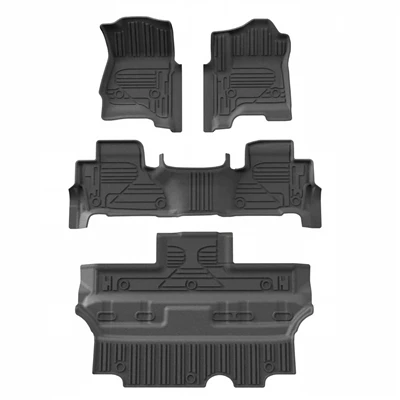
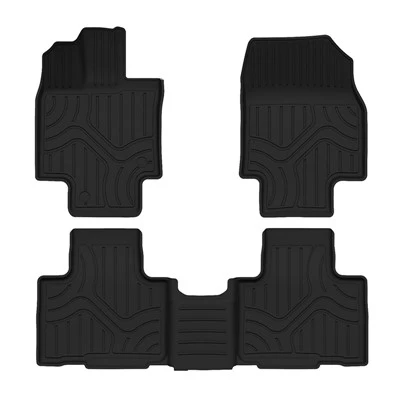
For many buyers, an OEM car mat project starts with a simple question: "How much does it cost?"
But for a manufacturer, price is rarely the first question that should be answered.
Before a supplier can accurately evaluate an OEM car mat project, it needs to understand the vehicle application, product structure, target quantity, customization requirements, quality expectations, packaging and delivery schedule. Missing information at this stage can lead to repeated quotation changes, sample revisions, tooling adjustments or unexpected delays later.
A better approach is to start with a clear OEM project brief rather than a simple price request.
This article explains the eight key areas buyers should prepare before contacting an OEM car mat manufacturer, with a particular focus on fitment, tooling and production decisions that can affect the project from sampling to mass production.

TPE Chevrolet Equinox Floor Mats
1. Prepare Complete Vehicle Fitment Information
Vehicle fitment should be the first item on your OEM car mat project brief.
At minimum, provide the vehicle brand, model and model year. For a professional OEM project, however, this is often not enough. Buyers should also provide information such as the vehicle generation, facelift version, left-hand-drive or right-hand-drive configuration, trim or floor configuration, and the exact set of mats required.
Why does this matter?
Because vehicle fitment is not simply a matter of copying the name of a car model. In actual development work, engineers need to validate the physical vehicle data and consider factors such as practical clearance, interference and material shrinkage. Kangyu's mold development team also notes that the same model can show practical differences between production batches, which is why multiple scans and real-vehicle validation may be required during development.
This makes one principle especially important:
Vehicle fitment is an engineering validation problem, not just a model-name problem.
Before requesting a quotation, prepare a simple vehicle application table:
| Item | Example |
|---|---|
| Brand | Toyota |
| Model | RAV4 |
| Model Year | 2026 |
| Generation | 6th generation |
| Drive Side | LHD |
| Product Set | Front + rear |
| Target Market | USA |
For multi-model projects, provide the complete list rather than sending vehicle applications one by one. A clear vehicle list helps the supplier determine which applications can use existing tooling and which may require new development.
2. Define What the Product Needs to Achieve
Do not simply tell the manufacturer that you want "high-quality car mats."
Define what high quality means for your market.
For one buyer, the priority may be premium appearance and detailed surface texture. For another, the main goal may be competitive pricing for a wholesale program. An e-commerce brand may prioritize packaging and logo customization, while a distributor may care more about durable construction and consistent fitment across a large number of vehicle models.
A useful OEM brief should therefore specify:
- Material preference
- Product structure
- Target thickness
- Surface texture
- Coverage area
- Color
- Anti-slip requirements
- Logo requirements
- Packaging requirements
TPE is especially relevant for Kangyu's product range. The company describes its TPE floor mats as odor-free, waterproof, anti-slip, wear-resistant and easy to clean, using new materials that are recyclable.
For buyers considering 【TPE Car Floor Mats】, the key question is not simply whether TPE is available. It is whether the selected construction, texture and manufacturing process match the product positioning you want to sell.
3. Know Your Expected Quantity by Vehicle Model
"500 sets" is useful information, but it is still not a complete production plan.
A supplier needs to know how that quantity is distributed across vehicle applications.
For example:
- Toyota RAV4 - 150 sets
- Honda CR-V - 100 sets
- Tesla Model Y - 200 sets
- Other models - 50 sets
This distribution can affect tooling utilization, production scheduling, inventory planning and packaging.
It is also important to distinguish between your initial test order and your expected recurring volume.
A buyer launching a new brand may start with a relatively small order to test market demand. A distributor may already have established sales channels and need regular replenishment. These two projects may use the same product, but their production and inventory strategies can be very different.
Kangyu's current OEM information supports both smaller customized orders and large-volume purchasing. Its stated MOQ is 10 pieces, while customer order examples include multi-model bulk purchases and large e-commerce projects.
For a B2B buyer, giving the supplier an estimated quantity by model is much more useful than simply asking, "What is your MOQ?"
4. Decide Whether You Need Existing Tooling or New Mold Development
One of the biggest differences between a standard bulk order and a true OEM project is whether the required vehicle application already exists.
Ask the manufacturer:
Do you already have a suitable mold for this vehicle?
If the answer is yes, the project may move relatively quickly into sampling and production.
If the answer is no, tooling development becomes part of the project.
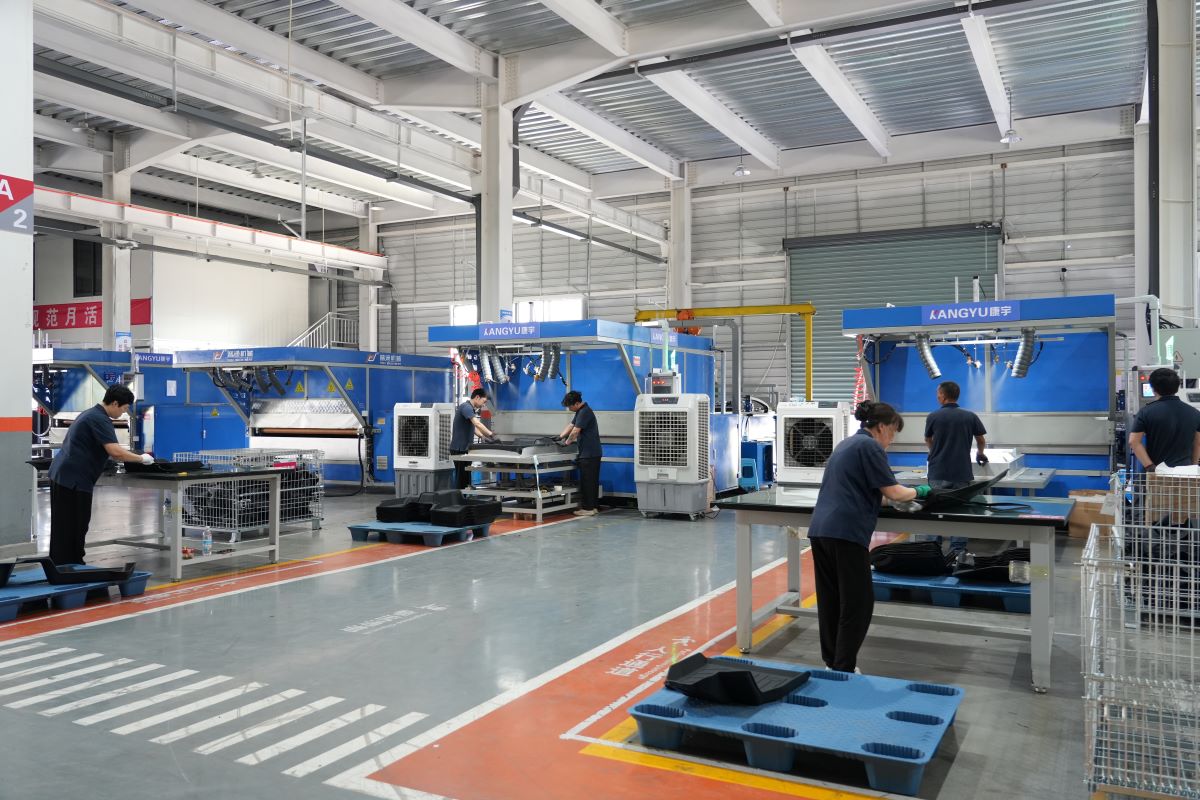
Kangyu's internal development process includes vehicle 3D scanning, data processing, product design, pattern review, mold manufacturing, sample development, real-vehicle trial fitting, testing and final mass production.
The company currently reports more than 800 vehicle mold applications and a dedicated mold and product development capability.
For a buyer, this means tooling should be treated as a project decision, not simply a manufacturing detail.
A useful question is:
"Which parts of my vehicle range can use existing tooling, and which applications require new mold development?"
This can give you a much clearer understanding of cost and lead time before approving the project.

5. Discuss the Manufacturing Process Before Finalizing the Product
Buyers do not always need to choose the manufacturing process themselves, but they should understand why the supplier recommends a particular route.
Kangyu currently works with three main forming processes: male-mold vacuum forming, female-mold vacuum forming and injection molding. The company also identifies a different role for each process. Male-mold forming is used for high-end applications and large-volume orders, while female-mold forming can support cost-control objectives. Injection molding provides high forming precision and clear detail.
In practical terms, the buyer should communicate four things:
Target market + expected volume + appearance requirements + cost target.
The manufacturer can then recommend the appropriate process.
This is better than saying, "I want injection molding," without explaining why.
For example, a premium private-label product may justify a more appearance-focused process, while a high-volume wholesale program may place greater emphasis on production efficiency and cost control.
This is one of the areas where a technically experienced supplier can help prevent an expensive mismatch between product positioning and manufacturing method.
6. Prepare Your Branding and Packaging Requirements
OEM projects often involve more than the mat itself.
Before production begins, decide whether you need:
- Embossed or printed logo
- Custom color
- Custom surface texture
- Private-label packaging
- Carton markings
- Product labels
- Barcodes or SKU identification
- Neutral packaging
These details should be defined before mass production rather than added at the last minute.
Kangyu supports logo, color, vehicle-specific and packaging customization, and has its own packaging line for options such as cartons and pallet packaging.
For international buyers, this is particularly important because packaging often needs to match the requirements of a specific sales channel.
A good OEM project brief should therefore include a simple statement such as:
"Private-label packaging required. Custom logo on product. Neutral outer carton with customer SKU."
The more specific the requirement, the less room there is for interpretation.
7. Define Your Sample and Quality Approval Process
A sample should not be treated as merely something to "look at."
For an OEM car mat project, the sample should become a reference point for production.
Before approving the sample, buyers should define what will be checked:
- Overall fitment
- Edge position
- Fastener or clip compatibility
- Pedal clearance
- Surface appearance
- Texture
- Color
- Odor
- Product dimensions
- Packaging condition
Kangyu's real development workflow includes TO samples, real-vehicle trial installation, trial production, mass-production samples and testing before batch production.
Its quality team also checks dimensional accuracy, appearance defects and odor, with repeated real-vehicle fitting used to verify new vehicle applications.
This is important because some problems cannot be identified from a drawing alone.
The company has encountered fitment-related issues caused by inaccurate scan data and mold damage or uneven areas that could result in curled edges. The corrective approach involved mold repair, grinding, testing and adjustment before the product was approved.
For buyers, the lesson is simple:
Approve the sample against measurable criteria, not just appearance.
8. Set Your Timeline, Delivery and Compliance Requirements Early
Finally, give the manufacturer a realistic project deadline.
Do not simply say:
"We need it urgently."
Instead, define the milestones:
Sample required: October 10
Sample approval: October 15
Mass production: October 16–25
Shipment required: October 28
Then ask the supplier to confirm whether the tooling, sampling and production schedule can support the target date.
Kangyu currently states approximately 3–5 days for stocked products, 7–10 days for standard customization and around 40 days for mold-development projects. Actual lead time will depend on the product and project scope.
Also clarify compliance requirements before production starts. Depending on your market and customer requirements, you may need documents such as RoHS-related test reports, quality certificates or inspection documentation. Kangyu reports IATF 16949, ISO 9001, ISO 14001 and other management certifications, together with SGS and RoHS-related product documentation.
This is much easier to manage before production than after the goods are finished.

A Practical OEM Car Mat Project Brief
Before contacting a supplier, buyers can prepare the following one-page brief:
Vehicle Information
Brand / Model / Year / Generation / LHD or RHD / Trim / Required mat set
Product Requirements
TPE / Dual-layer carpet / Thickness / Texture / Color / Coverage / Anti-slip requirements
Branding
Logo / Private label / Color / Packaging / Label / SKU
Order Plan
Sample quantity / Initial order quantity / Quantity by vehicle / Expected repeat volume
Tooling
Existing mold preferred / New mold required / Target development date
Quality Requirements
Fitment / Appearance / Odor / Dimensions / Fasteners / Testing documents
Delivery
Sample deadline / Production deadline / Shipping destination / Trade term
This document gives the manufacturer enough information to start a meaningful technical and commercial discussion.
Conclusion: Start With the Project Brief, Not the Price
A successful OEM car mat project does not begin with a price list. It begins with clear project inputs.
The most important information is usually not complicated: define the exact vehicle application, explain the product requirements, estimate the volume, clarify branding and packaging, understand whether new tooling is needed, establish sample approval criteria and communicate the delivery target.
Most importantly, do not treat vehicle fitment as a simple product label. As practical mold-development experience shows, accurate fitment can require 3D scanning, consideration of clearance and material shrinkage, and repeated real-vehicle validation.
When these details are prepared before the quotation stage, both buyer and manufacturer have a clearer project scope. That can reduce unnecessary revisions, improve cost visibility and make the transition from sample to mass production much smoother.